Thursday, January 21, 2016

Jaguar Lives - Joe Lewis (1978) - Peking Road, Kowloon

Time for a new film and back to colour for the time being as we follow Joe Lewis as the 'Jaguar' pursuing a criminal mastermind. Joe was in fact a famous tournament fighter back in the 1960's and is often credited with the development of kickboxing and full-contact karate. Not many people know that he was also a friend of Bruce Lee's during the 60's and was even trained by him for a time before a much publicised falling out. Anyway, first off the bat is a visit to somewhere that should be familiar to regular readers of this blog, it's Peking Road in Tsim Sha Tsui with the famous Club Tasogare sign.


And for a Bruce bonus, here is Joe walking up the side alley on Peking Road which used to be the access path for the Red Lips bar. The bar has gone but the alleyway still exists between the blocks that front Lock Road and Hankow Road. These days it's used by vendors for small stalls selling trinkets and bags etc.

Monday, January 18, 2016

Macao - Robert Mitchum (1952) - Inner Harbour, Macau

Another black and white film noir, this time starring Robert Mitchum who was featured on this blog last year courtesy of his starring role in Robert Clouse's The Amsterdam Kill. Macao was one of the first western films to be set in the "Far East" and unlike Target Hong Kong (made on the cheap using stock footage from Hong Kong and Shanghai to set the scene), RKO (the production company) sent  cameraman, Dick Davol, to Macau and Hong Kong in order to capture various bits of footage to be interwoven into the story as well as used for back projection back at the studio.

An interesting feature of Davol's trip seems to be that he had to run up a rather significant expense account paying bribes to the local authorities so he could film notably this included the Police Forces of both HK and Macau as well as the various boat owners, immigration officers, customs officers and even the Communist patrol boat crews!

Anyway, we shall start off this particular film with a view from the inner harbour looking towards the southern end of the peninsula. The camera work is a bit blurry and being black and white adds a little to the lack of clarity but if you looks carefully you should be able to the see the back end of Penha Church up on the hill (top left) and directly under it, about halfway down the hill, looks to be the Moorish Barracks building - the latter caught at a time when it could still be seen from sea level.


I don't know what the curved building is on the waterfront but its position tallies with the modern day Capitania Dos Portos (i.e. Macau Port Authority). You can just see the low rise shop houses along the waterfront (Rua Do Almirante Sergio), there are a few examples left but are now mostly hidden from view by various developments that have cropped up along the old pier areas.

Sunday, January 17, 2016

Macao - Robert Mitchum (1952) - Rua do Visconde Paco de Arcos, Macau

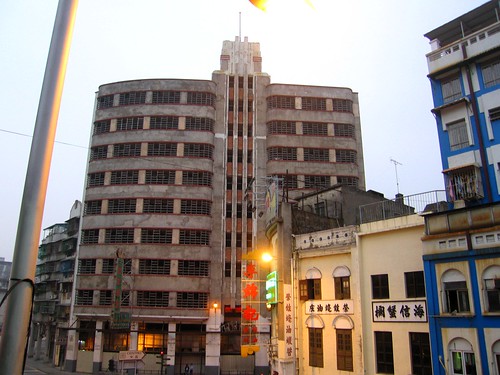
Having just been talking about the Hotel Grande in the previous post, this view shows the back of the hotel from the vantage point of the inner harbour area.


The hotel is actually the large structure on the right. I've passed this place almost every time I have visited Macau and never realised it had such a varied history. The building looks quite modern, at least compared to the older shop houses that line Avenida de Almeida Ribeiro next to it and was in fact built in 1940, just before the war broke out between Japan and neighbouring China. Macau, being a Portuguese colony remained neutral during the occupation years and as a result saw lots of wealthy refugees from Hong Kong escaping the Japanese oppression.

The Grande Hotel (Chinese name Kwok Chai Tsau Dim) was built by the Tai Hing Company - a company owned by the Fu family who controlled the gambling monopoly between 1937 and 1962. Their lasting contribution to Macau, other than this rather elegant (though dilapidated) shell of a building was to introduce baccarat into local casinos. It was supposedly built with Chinese patrons in mind, as opposed to the various other luxury hotels that catered largely for western visitors. On completion it was the tallest structure in Macau, topping out higher than its neighbour Hotel Central (which can be seen in the background in the above screen caps). Incidentally, it was the Fu Family that built and owned the popular Furama Hotel in Hong Kong.

Unfortunately it didn't take long before the place descended into a rather less-than-salubrious destination with all manner of crimes going on including murders, prostitution and drug dealing etc and it eventually closed down in the 1990s and has been sitting there ever since getting more and more decrepit. I think this is a big shame because it is actually a very attractive building. I recently heard some rumours that there was an investor waiting to restore it to its former (pre-vice) glory and I hope it happens because something needs to be done and it would be a shame to just knock it down.

Incidentally, the wooden pier you can see in the foreground is now occupied by the Sofitel development and the tall building on the left is the (also still standing) Hotel East Asia. This isn't the Ponte No.16 because that is a large concrete art deco structure, so this looks more likely to be the next pier up, Ponte 18 (I don't know if there was a #17). I'm hoping someone more familiar with Macau can comment. Anyway, this was the pier where passengers were filmed disembarking from the ferry (I assume it was the Tak Shing that was featured in the movie, but I haven't looked closely enough to confirm yet). The footage was used twice, once on it sown and then a few seconds later as the background for the studio scenes of Mitchum and Russell disembarking.

Sadly, I don't have my own picture of the Hotel Grande but here is one courtesy of meckleychina on FLICKR. He also has a great collection of pictures of Asian art deco if you are interested.


Friday, January 15, 2016

Macao - Robert Mitchum (1952) - Avenida de Almeida Ribeiro, Macau

A brief but almost recognisable glimpse along the far (western) end of  Avenida de Almeida Ribeiro aka San Ma Lo. This is one of my favourite roads in Macau because it is largely lined along both sides with columned shop houses, including a couple of interesting pawn shops. Probably the most well-known film featuring this road was Indiana Jones and the Temple of Doom.

Anyway, the view we get in this film is of the end that used to open out onto the inner harbour area with the less-than-salubrious but long closed down (and now derelict) Hotel Grande at the end. Despite the poor film quality, you can still make out some distinguishing features that give away the location including some of the cornice of the near archway and the extra high columns that support the front facade of the Hotel Grande building.


There's an interesting history to the aforementioned hotel, but I'll cover that in the next post where we see a bit more of it. Until then, here is the rough approximation of the modern view courtesy of Streetview. Note that the open end of the road is now blocked by the Sofitel. 

Thursday, January 14, 2016

Macao - Robert Mitchum (1952) - Tak Shing Ferry to Macau

Three years before we saw the Tak Shing in full colour glory courtesy of Clark Gable and Soldier of Fortune, it was featured in Mitchum's Macao as the ferry supposedly taking him and his cohorts to the enclave. The only difference between 1952 and 1955 seems to be that the ferry had a lick of paint on its hull before appearing on Soldier of Fortune in full colour.

 
Of course, Mitchum and co didn't actually travel on this ferry at all. All their scenes were filmed back in the studio in front of the back-projected footage expensively procured by Dick Davol, but it's nice to see he did get some decent footage of this famous Macau ferry boat.

Monday, January 11, 2016

The Chairman - Gregory Peck (1969) - More Harbour views

The last of the scenes from The Chairman (at least until I can get a street scene identified) showing various views taken from the harbour. I guess this was all Thompson (the director) could take without attracting unwanted attention from the authorities after being given the old heave ho.

The first shots shows one of the old HYF vehicular ferries plying the route between Central and Jordan Road by the looks of the way the boat is facing. In the background we can see Ocean Terminal with the Hongkong Hotel immediately behind it and Star House. Now, officially, the Hongkong Hotel didn't open until 1970 so I guess the filmmakers managed to capture it when it was still being fitted out - it certainly looks like the building was already completed. Star House and Ocean Terminal were fairly new at this time anyway.


Here's another angle of Ocean Terminal - probably taken from the Mandarin Oriental Hotel using a telephoto lens. The angle certainly matches the view we saw in the earlier post. In the closer shot below though we can see Yau Ma Tei Typhoon Shelter behind Ocean Terminal and the Ferry Point Estate at the far end of it on the left hand side of the lower picture.


Finally, in order the demonstrate how clear everything used to be, compared to today's smoggy and hazy harbour views, here is a nice shot from the harbour looking over to the centre of HK Island (towards Causeway Bay and North Point area).

Sunday, January 10, 2016

The Chairman - Gregory Peck (1969) - Hau Wong Road, Kowloon City

A small snippet from the same plane scene I posted about earlier but I kept this one for later because there is a quick glimpse of a famous HK restaurant in it.


There is a surprising amount of survivors from this small scene, most notably the Lok Hau Fuk Restaurant (樂口福酒家) whose sign can be seen in the first picture - it's the blue sign directly underneath the plane. I took a picture of this place several years ago on one of my early explorations of HK and by pure coincidence was told a few years later that it was featured in a famous local HK film (directed by Johnnie To) called The Mission (1999). Anyway, the restaurant is one of the few columned shop house survivors that can be found in Kowloon City along Hau Wong Road. Here is my picture (taken sometime around 2008 I think).


It's not a match for the film in terms of angle but that doesn't matter because we can get a pretty good match via Streetview. The grab below shows that most of the buildings seen in 1968 (The Chairman was released in 1969 but actually filmed the year before) including the restaurant, the curved building on the corner with Prince Edward Road West and the tenement behind it further along Hau Wong Road.

The only real change in this area (other than the rather significant removal of the airport to Chek Lap Kok) is that the lower screen grab shows a clear view over to the airport area as the plane flies over. This view is now obscured (and has been for many years) by the flyover built above Prince Edward Road. You can see it below and compare it to the last picture in the series posted above.

Friday, January 8, 2016

The Chairman - Gregory Peck (1969) - View over Victoria Harbour, Hong Kong

In the film Peck stays at an unnamed hotel, but it's quite obvious from the view that the film crew managed to gain access to a balcony/terrace (or perhaps roof) on the Mandarin Oriental. I guess it's possible they were staying there and took advantage of the location to get some shots in before having to leave.

We see the same view a couple of times, once as a scene setter and then later when Peck's character (he's called Hathaway in the film) peers out of his room window.

First there is the initial panning shot which I also merged into a fairly decent panorama as you can see. It's a pretty good look over the harbour taking in Kowloon as well as nearer sites such as the old Star Ferry pier with its famous and dearly missed clock as well as Queen's Pier (also dearly missed but due to make a return if it hasn't already) and the white block in the lower left is City Hall.


Then later in the film we get an additional look the other way showing the buildings along Connaught Road. Some of these buildings do still exist despite everything around them changing. You can also see the old vehicular ferry pier and the large car park that was eventually turned into Exchange Square.

The Chairman - Gregory Peck (1969) - Queen's Road Central, Hong Kong

Just a brief scene (as they all were by necessity) of Queen's Road Central as Peck's car drives through the city. The white building at the back is the newly completed (in 1968) Hang Lung House (although it looks to have since received some slight remodeling at the top) at 184 - 192 Queen's Road Central which puts us on the curve in the road just before we reach Hillier Street.


I've included the Streetview below for a decent comparison. I leave it to you to decide which version has the most character.

Thursday, January 7, 2016

The Chairman - Gregory Peck (1969) - Kai Tak Airport, Kowloon

Welcome to the first post of 2016 and a new film to look at. This is The Chairman starring Gregory Peck as a genetics professor who is recruited by the various allied spy agencies to find out if Communist China has been able to geo-engineer some sort of super crop.

The film only has a few scenes filmed in Hong Kong, but there is a good reason for that. When the anti-communist nature of the film's plot leaked out, there were protests by local Communist sympathisers (it was filmed only one year after the 1967 Communist riots) who hoisted effigies of both Peck and American President, Lyndon Johnson. As a result, the local HK Colonial Govt figured it was too hot a potato to handle and kicked out the film crew. The director, J. Lee Thompson, was able to snatch a few sneaky scenes though before leaving. The crew went on to film most of the Asian scenery in Taiwan (including some shots around Keelung docks) and the finale was actually filmed in Wales which stood in for rural China.

Anyway, as with all films that have some HK scenes, the stage is set by seeing the rather cliched (but never boring, for me at least) shot of a plane landing at the territory's former airport in Kowloon. We get a rather nice view of the area in Kowloon Tong where St George's school used to stand (I was told this is where the Australian International School stands now). It's the low rise building directly below the plane in the second shot. Also in the 2nd and 3rd shots are the former version of Osborn Barracks when it still consisted largely of Nissen huts. 


Finally, a rather nice shot looking directly down the line of the famous runway, with the low rises of Kowloon City on the ground underneath.