Friday, June 19, 2015

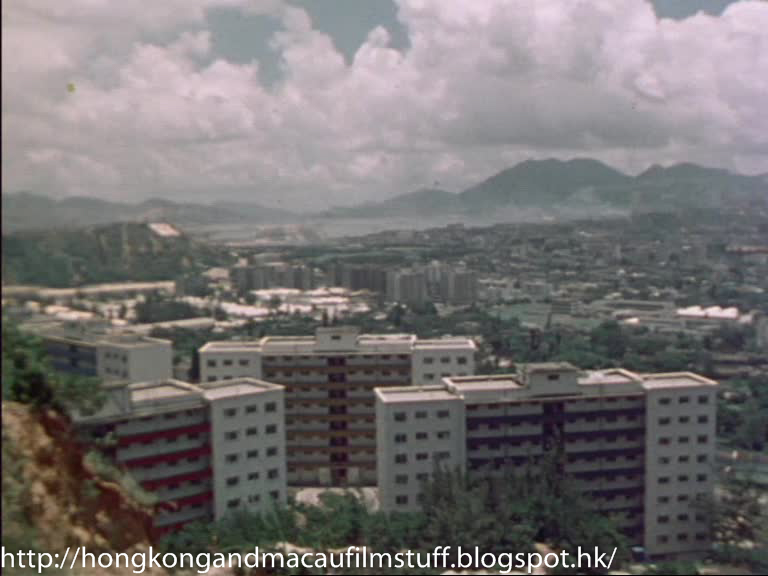
Kung Fu Killers - Grant Page (1974) - View from Lung Cheung Road, Kowloon

Always one for a bit of adrenaline seeking, whilst on his trip to HK to interview various people around the film industry here Grant Page also decides to do some impromptu stunt work including zip lining down Lion Rock and its surrounding area.

I'll post these later but it looks as though while the film crew (or cameraman. at the very least) was in the vicinity they took a nice shot from what looks to be Lung Cheung Road - although slightly east of the famous Lung Cheung Road Lookout.


It's not so much what there is to see here but what there isn't. Simply put, all the greenery in the dip has all completely gone! What stands in its place now is the revamped Kowloon Tong Station (and upgraded double track) and the massive Festival Walk Mall. Here's a quick stitch to give a better panorama.


On the left are the old Govt quarters that have since been demolished and replaced by No.1 Beacon Hill and the buildings on the lower right are the ones (still standing) that line the lower section of Beacon Hill Road (which proves this view is not from the nearby Lookout). You can just make out the checkerboard way over centre left and the old single track rail line centre picture. The scarred hill to the right of the track is the hillside that was leveled to make way for the mall and surrounding buildings (including City University campus). Hong Kong Island, of course, is the ridge line in the far distance.

For a similar angle - but taken from the nearby Lookout, you can view this post from my other blog.

Thursday, June 18, 2015

Kung Fu Killers - Grant Page (1974) - Hong Kong International Airport, Kai Tak

A few posts ago we were taking a quick look at Wang Yu in The Man From Hong Kong. It was a brief look because only a small portion of it featured locations in Hong Kong and those scenes were largely dominated by the rather excellent hand gliding sequence undertaken by Australia's premier stuntman, Grant Page.

Luckily for us, Page was featured in this documentary on the 70's kung fu film boom - Kung Fu Killers - that looks as though it was probably (though I can't be certain) shot when Brian Trenchard-Smith (director of both films) and Page were in town to film the aerial scenes from the Wang Yu film.

Anyway, the doc is worth including because there are some interesting sites and views included starting off with this brief but iconic view of a Singapore Airlines plane coming in to land at the airport.

Wednesday, June 17, 2015

Soldier of Fortune - Clark Gable (1955) - Tak Shing Ferry to Macau

I have been re watching Soldier of Fortune recently (following on from the post concerning Ronald Chow) and found a few more grabs that are worthy of including such as this brief glimpse of the Macau<>Hong Kong Ferry: Tak Shing.


I don't have any information about the vessel other than that it was a real ship that toiled between Hong Kong and Macau. In the film it is the ferry that Hayward's character, Mrs Hoyt, catches to Macau and witnesses the arrest of Richard Loo's character by Communist sailors.

I did notice that the ship gets a mention on this thread over on Gwulo (and I have added a picture to the thread) and Thomas Ngan - frequent saviour of my identification exploits here - has mentioned that Ian Fleming traveled on the ferry when he visited HK.

Okay, it's not a film location as such (well, I guess it is a mobile one) but worthy of including here.

Sunday, June 14, 2015

Love is a Many-Splendored Thing - William Holden (1955) - Vehicular Ferry Pier, Central

Do you remember the flipped film I found during That Man Bolt? Well it seems that the same thing was going on 20 years earlier with a small sequence involving a vehicular ferry. It's the scene after when Suyin goes to meet Elliot at Kai Tak and they return to HK Island afterwards. It's very quick but there's a nice view of the island and the ferry as it steams towards it. However, if you are familiar with HK scenery you should immediately know that this scene has been flipped with what should be the western flank of HK Island appearing on what appears to be the east. The correct view can be seen in the second picture.

To round off the scene there is a quick glimpse of, what I assume to be, the Central vehicular ferry pier as the ferry pulls in to dock.


I've mentioned it before but there is still a vehicular service that runs in HK but it is limited to those vehicles carry good too dangerous to travel via the harbour tunnels.

Tuesday, June 9, 2015

Love is a Many-Splendored Thing - William Holden (1955) - Hong Kong - Macau Ferry Pier, Sheung Wan

A closer view of the old ferry terminal (if you can use that term to describe what it used to be) and we get a slightly better view of one of the ferries - although it's not the one that Suyin gets on board. First we have the view over to the other boat. 


I'm sure someone out there can tell me which one it was ;-). The following pictures show a life ring with the name Fat Shan on it. We've seen the Nam Shan and the Wah Shan on this blog before but I'm not sure we have come across the Fat Shan before, despite the fact that it was a fairly well known vessel. Sadly we don't get to see it anyway as the camera seems to be filming from on board the ship - as you can see from the bottom image.

Sunday, June 7, 2015

Love is a Many-Splendored Thing - William Holden (1955) - Hong Kong Island Waterfront, Opening titles

One of the standout sequences for me in this film is the opening scene where we are treated to a birds eye view of the northern shore of HK Island. Granted, the views are marred a bit by the titles but once they have finished we still see a few seconds of film that show what the place looked like before the obsession with skyscrapers ruined the view.

The sequence starts off the west side of HK Island with Green island immediately below the camera (next to the 'g' of the top image).


 As the camera (attached to a low-flying plane I suspect) flies on we can see a road on the right hand side that runs parallel to the waterfront - (just under the name 'Doss' below). You can see it a bit clearer in the second picture below as the camera gets closer. I'm open to corrections, but this looks to me to be the western end of Queen's Road West where it joins onto to Kennedy Town Praya. The Praya is separated from the sea by slightly more reclamation now, at this area, but not significantly.


Moving a little further along again and now the camera is taking us past the waterfront Connaught Road West around the area of Whitty Street and further east. None of these waterfront buildings exist anymore and these days the waterfront has given way to some ugly reclamation that houses the Western Wholesale Food Market.


Now that the titles are out of the way the camera continues on and we get an open view of Connaught Road and Des Voeux Road West which runs parallel one block to the south. In other words the wide road we can see below. 


One of the interesting things about Hong Kong is that whilst development goes on all around on the various plots of land, the roads' general shape tends to stay the same. This isn't true all the time of course and indeed sometimes smaller roads completely disappear, but looking above you can see the bend that Des Voeux Road makes (in the bottom picture) as it turns north next to Queen Street and Ko Shing Street. For a modern reference, this corner is where the IBIS Hotel currently stands.

Finally, one last zoom over the bend in Des Voeux Road West and we can see the Macau bound ferries at the waterfront. The only building that was standing in the 1950's that is still around is Western Market, and if you look very closely you can see its roof just in front of the taller building with the arched openings (I think this was a hotel, but I can't find the name of it). These days, most of the building stock around here now dates back only as far as the early 70's.


I'm hoping a ferry fan will be able to discern which ships were at port. They look like two distinctive types one of which perhaps is the Fat Shan that will crop up in my next post, in name if not in physical form.

Friday, June 5, 2015

Love is a Many-Splendored Thing - William Holden (1955) - Kai Tak Airport, Kowloon

Most of the visits we have made to Kai Tak courtesy of the various films I've posted about here (and almost every one - with a few exceptions - has a scene at Kai Tak) have been of the post 1958 variety. This means that most of our films show planes taking off and landing along the famous runway that jutted out into Kowloon Bay.

However, in this film we see the airport in its former incarnation (and location) as a rather more modest development on the shores of the bay in the San Po Kong area. It wasn't until a few years later that the airport was shifted south with the building of the new (more familiar) runway and the whole of the area you see on these screen grabs below became an industrial area filled with factories (trivia: it was in one of the factories in San Po Kong that an industrial dispute led to the outbreak of the leftist riots in 1967).

The east of HK Island in the far background
Looking northeast - perhaps with a seaplane in the background?

The next pictures are a sequence where we see Suyin's plane land, supposedly, in Chung King but actually we are just seeing another angle of Kai Tak with Diamond Hill area in the background.


It looks to me as though it may say HAEC on that hangar rooftop. HAEC was the previous name for HAECO.

Later on in the film, Suyin goes to meet Mark Elliot at the airport when he returns from Singapore we get to see the very distinctive eastern slope of Kowloon Peak in the background (and I guess the hill on the right of the top shot was what became Anderson Road Quarry?).


And a final parting shot of Suyin with the iconic Lion Rock behind her as she looks through the fencing.

Wednesday, June 3, 2015

Remembering Ronald Chow

One of the great things about this blog is that I get contact from a wide variety of people. Some get in touch to say thanks, some get in touch to offer me suggestions on films I may not have been aware of (it happens a lot, and I really appreciate the pointers), some people are curious about a location in a film that I haven't already covered, and some people are just like-minded individuals who share this rather weird obsession with film locations (it's more popular than you would think!).

Recently I was contacted by a women in the US who was keen to get a copy of some of the screen grabs I had put up for Soldier of Fortune. Soldier of Fortune is the Clark Gable feature made around the same time as Love is a Many-Splendored Thing that featured Susan Hayward and Michael Rennie as well as some fantastic Hong Kone locations including King Yin Lei and the Barker Road Peak Tram stop.

The film is quite famous in that its female lead, Susan Hayward, couldn't get to Hong Kong to shoot any scenes due to an ongoing custody battle over her children with her ex-husband (Jess Barker). As a result of her absence during key HK-located scenes (such as the rickshaw ride around Central, the scenes outside the Peninsula Hotel and also one at the aforementioned Barker Road Tram Stop) Hayward's double, Dale Logue, was used as a stand in and filmed from a distance so that no one would tell the difference. When I originally started looking at these films there was a bit of speculation that the stand in was Jennifer Jones - who was also in HK for the filming of Love is a Many-Splendored Thing. I'm sure this was spurred on by the fact that both films were released in 1955 and shared Buddy Adler as a producer, but after a bit of research it turns out that Dale Logue was indeed the stand in on this and many other of Hayward's later films. Also, Soldier of Fortune was filmed late in 1954 and Love is a Many-Splendored Thing didn't start filming until nearly 6 months later.

So anyway, back to that email contact I mentioned. It turns out there is another link between the two films other than Buddy Adler. The link is a gentleman called Ronald Chow. Here is an edited version of the email to explain further:
Hi...I am interested in a photo in your...blog... 
Of particular interest is the first photo in a series of three, featuring Michael Rennie and an unknown man walking towards the Marine Police HQ. That man was my father, Ronald Chow, who passed away 2 years ago [in 2013]. He happened to be the location scout for this film, as well as Love is a Many-Splendored Thing, and was given a bit part in the movie. This movie was made 7 years before I was born. He had a short career in the movie industry.

He was very proud of his involvement in this movie and I'd love it if I could obtain a print or JPEG file to include in my memories of him.
So there you go, the man responsible for tracking down and organising all those fantastic locations for both of these films back in 1954/5 - many of which I have been able to include here in the blog - was Ronald Chow.

So I went back to look at Soldier of Fortune again (and I'll be updating my blog posts with better quality grabs in the very near future) and sent a whole bunch of screen captures off to his daughter.

In case you haven't seen the film, or in case you have but want to know who Ronald was, he played Merryweather's (played by Michael Rennie) local police assistant who went by the moniker of '303'. He was in several scenes and I have included a few grabs from each below. The first scene is on the Marine Police patrol boat as Rennie's character is on the lookout for Susan Hayward's missing husband (played by Gene Barry). Ronald is the chap in blue inside the wheelhouse.


Part of the same scene but now on board a sampan as they go looking amongst the 'flower boats' in the typhoon shelter.


Here is Ronald and Michael Rennie in front of the old Marine Police HQ in TST (now the Hullet Hotel).


And finally, one last appearance outside the Peninsula Hotel just next to the Marine Police HQ.


So there you have it, a small piece of cinema history. Sadly, as you have read, Ronald passed away only 2 years ago but at least we can remember him in our own little way here and give him some late thanks for the seemingly small but actually quite significant contribution he made to these films.