Showing posts with label Macao. Show all posts

Saturday, February 3, 2024

Macao V Forbidden (recycling Dick Davol's Macau footage)

I realised that when I posted my recent Forbidden post I had neglected to provide any comparisons to show that the footage used in that movie was simply recycled from the footage Dick Davol had shot for Macao.

I found a couple of screen grabs that provide a reasonable comparison. They're not frame-to-frame matches but you get the general idea. It may just be the print quality available on Youtube, but the original Macao footage (first image) is much clearer. 


Another matching shot is the footage used for the passengers disembarking the ferry. In Macao, the footage is used alone first, and then is repeated for a back-projection shot showing the main characters getting off the ferry. In Forbidden, it serves only as back projection for Tony Curtis' character alighting.


I'm sure there are plenty more examples but I don't have the patience to go through both films again at this point. Perhaps there wasn't any other real Macau footage available to a US studio at the time, and selling/licensing the footage to UIP for Forbidden may have recovered some of the costs incurred in filming Macao (which was a box office bomb). Or maybe the footage was Davol's to license out? He gets no credit on either film though.

Reminder: Macao was produced by RKO and Forbidden by UIP. There's an interesting snippet, for Macao, on the AFI catalog site that says the following:
In May 1948, HR [Hollywood Reporter] announced that Universal-International [UIP] had purchased the screen rights to a story entitled "Macao," which was described as a "post-war story, localed off the China coast.

It has not been determined if the Universal story is related to the RKO picture. RKO purchased Bob Williams' story in Aug 1949.

So perhaps there are closer links between the two films than just the footage? Even though it was shot and released later, it looks like Forbidden was in the pipeline around a year before Macao.

Thursday, January 12, 2023

Macao - Robert Mitchum (1952) - Shau Kei Wan Typhoon Shelter, Hong Kong

I'm yet to settle on a new film to start 2023, so instead here is a post from a film I first covered 6 years ago. As far as I am aware (so far), Macao was the first movie to incorporate location footage in Hong Kong and Macau specifically commissioned for the purpose - albeit back projection and establishing shots only. My previous posts on this film only included the Macau footage but if you look carefully at the beginning of the film, there is the following footage taken from the eastern edge of Shau Kei Wan Typhoon shelter.

Look carefully and you can see Lion Rock in the distance (centre frame), however, the area seen in the foreground has long since been reclaimed and redeveloped and now has the East Island Corridor running over the top of it on an elevated highway bridge.

I wonder how much more footage Dick Davol (the cinematogapher tasked with capturing it) shot and whether or not it has cropped up elsewhere?

Monday, January 18, 2016

Macao - Robert Mitchum (1952) - Inner Harbour, Macau

Another black and white film noir, this time starring Robert Mitchum who was featured on this blog last year courtesy of his starring role in Robert Clouse's The Amsterdam Kill. Macao was one of the first western films to be set in the "Far East" and unlike Target Hong Kong (made on the cheap using stock footage from Hong Kong and Shanghai to set the scene), RKO (the production company) sent  cameraman, Dick Davol, to Macau and Hong Kong in order to capture various bits of footage to be interwoven into the story as well as used for back projection back at the studio.

An interesting feature of Davol's trip seems to be that he had to run up a rather significant expense account paying bribes to the local authorities so he could film notably this included the Police Forces of both HK and Macau as well as the various boat owners, immigration officers, customs officers and even the Communist patrol boat crews!

Anyway, we shall start off this particular film with a view from the inner harbour looking towards the southern end of the peninsula. The camera work is a bit blurry and being black and white adds a little to the lack of clarity but if you looks carefully you should be able to the see the back end of Penha Church up on the hill (top left) and directly under it, about halfway down the hill, looks to be the Moorish Barracks building - the latter caught at a time when it could still be seen from sea level.


I don't know what the curved building is on the waterfront but its position tallies with the modern day Capitania Dos Portos (i.e. Macau Port Authority). You can just see the low rise shop houses along the waterfront (Rua Do Almirante Sergio), there are a few examples left but are now mostly hidden from view by various developments that have cropped up along the old pier areas.

Sunday, January 17, 2016

Macao - Robert Mitchum (1952) - Rua do Visconde Paco de Arcos, Macau

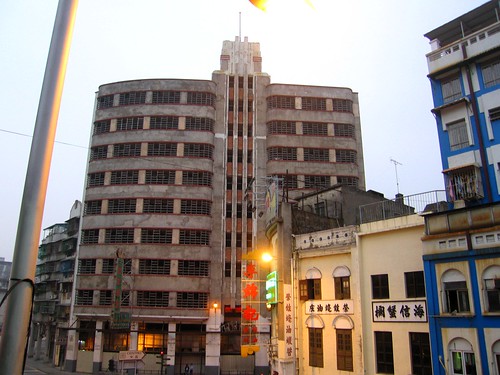
Having just been talking about the Hotel Grande in the previous post, this view shows the back of the hotel from the vantage point of the inner harbour area.


The hotel is actually the large structure on the right. I've passed this place almost every time I have visited Macau and never realised it had such a varied history. The building looks quite modern, at least compared to the older shop houses that line Avenida de Almeida Ribeiro next to it and was in fact built in 1940, just before the war broke out between Japan and neighbouring China. Macau, being a Portuguese colony remained neutral during the occupation years and as a result saw lots of wealthy refugees from Hong Kong escaping the Japanese oppression.

The Grande Hotel (Chinese name Kwok Chai Tsau Dim) was built by the Tai Hing Company - a company owned by the Fu family who controlled the gambling monopoly between 1937 and 1962. Their lasting contribution to Macau, other than this rather elegant (though dilapidated) shell of a building was to introduce baccarat into local casinos. It was supposedly built with Chinese patrons in mind, as opposed to the various other luxury hotels that catered largely for western visitors. On completion it was the tallest structure in Macau, topping out higher than its neighbour Hotel Central (which can be seen in the background in the above screen caps). Incidentally, it was the Fu Family that built and owned the popular Furama Hotel in Hong Kong.

Unfortunately it didn't take long before the place descended into a rather less-than-salubrious destination with all manner of crimes going on including murders, prostitution and drug dealing etc and it eventually closed down in the 1990s and has been sitting there ever since getting more and more decrepit. I think this is a big shame because it is actually a very attractive building. I recently heard some rumours that there was an investor waiting to restore it to its former (pre-vice) glory and I hope it happens because something needs to be done and it would be a shame to just knock it down.

Incidentally, the wooden pier you can see in the foreground is now occupied by the Sofitel development and the tall building on the left is the (also still standing) Hotel East Asia. This isn't the Ponte No.16 because that is a large concrete art deco structure, so this looks more likely to be the next pier up, Ponte 18 (I don't know if there was a #17). I'm hoping someone more familiar with Macau can comment. Anyway, this was the pier where passengers were filmed disembarking from the ferry (I assume it was the Tak Shing that was featured in the movie, but I haven't looked closely enough to confirm yet). The footage was used twice, once on it sown and then a few seconds later as the background for the studio scenes of Mitchum and Russell disembarking.

Sadly, I don't have my own picture of the Hotel Grande but here is one courtesy of meckleychina on FLICKR. He also has a great collection of pictures of Asian art deco if you are interested.


Friday, January 15, 2016

Macao - Robert Mitchum (1952) - Avenida de Almeida Ribeiro, Macau

A brief but almost recognisable glimpse along the far (western) end of  Avenida de Almeida Ribeiro aka San Ma Lo. This is one of my favourite roads in Macau because it is largely lined along both sides with columned shop houses, including a couple of interesting pawn shops. Probably the most well-known film featuring this road was Indiana Jones and the Temple of Doom.

Anyway, the view we get in this film is of the end that used to open out onto the inner harbour area with the less-than-salubrious but long closed down (and now derelict) Hotel Grande at the end. Despite the poor film quality, you can still make out some distinguishing features that give away the location including some of the cornice of the near archway and the extra high columns that support the front facade of the Hotel Grande building.


There's an interesting history to the aforementioned hotel, but I'll cover that in the next post where we see a bit more of it. Until then, here is the rough approximation of the modern view courtesy of Streetview. Note that the open end of the road is now blocked by the Sofitel. 

Thursday, January 14, 2016

Macao - Robert Mitchum (1952) - Tak Shing Ferry to Macau

Three years before we saw the Tak Shing in full colour glory courtesy of Clark Gable and Soldier of Fortune, it was featured in Mitchum's Macao as the ferry supposedly taking him and his cohorts to the enclave. The only difference between 1952 and 1955 seems to be that the ferry had a lick of paint on its hull before appearing on Soldier of Fortune in full colour.

 
Of course, Mitchum and co didn't actually travel on this ferry at all. All their scenes were filmed back in the studio in front of the back-projected footage expensively procured by Dick Davol, but it's nice to see he did get some decent footage of this famous Macau ferry boat.