
Wednesday, April 10, 2024
Golden Studios - Then and Now
As a long-time HK film fan, Golden Studios holds particular interest for me because it was the filming/production location of many classic kung fu and action films during the 70's and 80's. Golden Studios was, of course, the name of the studios owned and operated by Golden Harvest. Sadly the studios are no longer around, but below is an aerial photo of the area in Diamond Hill where the studio was located so that at least we can see where it was in relation to the area now.


Friday, April 5, 2024
The Water Margin - David Chiang (1972) - Shaws Movietown
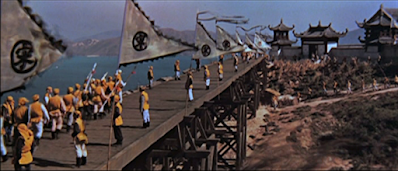
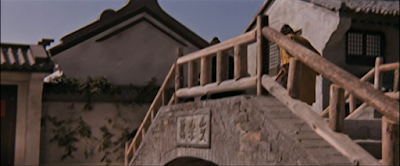
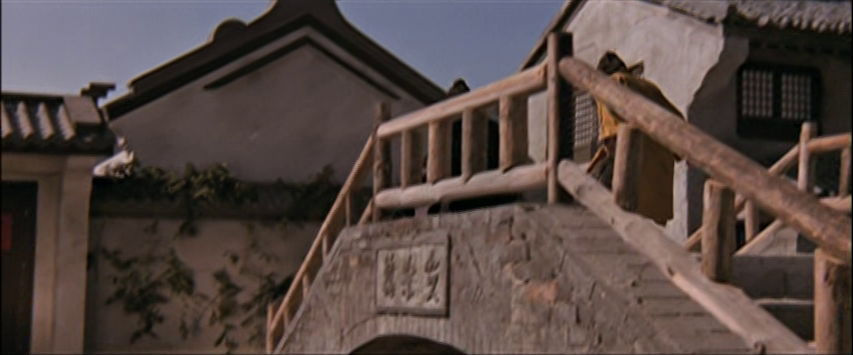
It wouldn't be a Shaw movie without at least a small mention of the Movietown sets. Anyway, there now follows a hiatus in posts as I look for new films to feature and perhaps resurrect some of the old film related history posts from the old blog. If anyone has a film they would like me to cover and can point me in the direction of a copy, then feel free to comment.




Thursday, April 4, 2024
The Water Margin - David Chiang (1972) - Ho Sheung Heung, North District
Back to Ho Sheung Heung and the location where Bruce Lee fought Sammo Hung in the opening scenes of Enter the Dragon. Despite taking me several months to locate, it turns out this place was a popular filming spot through the 70s. These days it's still fairly over grown and impenetrable but I still wait patiently for the day when some idiot accidentally starts a hillfire and reveals some lost film artifacts.
In this scene, Yan Ching (David Chiang) has just saved Jade Unicorn from being assassinated by his corrupt guards, and hangs around waiting to rob someone so he can get enough money to go to Liangshan and team up with the bandits. It turns out that the two people he decides to rob are Liangshan bandits.


In this scene, Yan Ching (David Chiang) has just saved Jade Unicorn from being assassinated by his corrupt guards, and hangs around waiting to rob someone so he can get enough money to go to Liangshan and team up with the bandits. It turns out that the two people he decides to rob are Liangshan bandits.


Tai Shek Mo (Crest Hill) in the background
Wednesday, April 3, 2024
The Water Margin - David Chiang (1972) - Pak Shek Au, North District
Here we are back at Pak Shek Au near Kwu Tung. It's a favoured filming location for many a 60s- and 70s-made period film thanks to its - then - relatively unspoilt environment. Since those days it has undergone significant change as small industrial sites (and their requisite corrugated iron and steel structures) occupied much of the central area. Although even now, those rather unsitely structures have themselves now been cleared to make way for the start of the much-heralded "Northern Metropolis".
In the scene below, Chao Gai, the bandit leader (played by Tung Lam), has just been ambushed and atttacked by Shi Wengong and is impaled with an arrow before being rescued by Lin Chong (Yueh Hwa).
The area below can be indentified by the presence of a small ridge in the background that has the English name on Open Street Map of "Mt Kirkpatrick" and "Mt Kilpatrick" on older ones. I suspect the older one is the correct name. In front was a flat area with a couple of large ponds that was later utilised for the aforementioned cluster of small industrial buildings as well as the community centre, sports pitch and camp site. Someone took a photo from the Tung Wah campsite which shows Mt Kirk/Kilpatrick in the background. It gives you an idea of how much the place has changed. Also, fans of the genre may be interested to compare the images below with the last image on my old post on The Fate of Lee Khan. It's more or less the same camera angle.


As Chao Gai tries to escape, he rides his horse to the east with a view towards Tai Shek Mo (Crest Hill). You can see a similar view in this shot from The Blood Brothers.


And...finally a view over to the distinctive peak of Ki Lun Shan which can be seen in this image from The Legend of the Seven Golden Vampires. In fact, you will see those two shots were taken from more or less the exact same place.

In the scene below, Chao Gai, the bandit leader (played by Tung Lam), has just been ambushed and atttacked by Shi Wengong and is impaled with an arrow before being rescued by Lin Chong (Yueh Hwa).
The area below can be indentified by the presence of a small ridge in the background that has the English name on Open Street Map of "Mt Kirkpatrick" and "Mt Kilpatrick" on older ones. I suspect the older one is the correct name. In front was a flat area with a couple of large ponds that was later utilised for the aforementioned cluster of small industrial buildings as well as the community centre, sports pitch and camp site. Someone took a photo from the Tung Wah campsite which shows Mt Kirk/Kilpatrick in the background. It gives you an idea of how much the place has changed. Also, fans of the genre may be interested to compare the images below with the last image on my old post on The Fate of Lee Khan. It's more or less the same camera angle.


As Chao Gai tries to escape, he rides his horse to the east with a view towards Tai Shek Mo (Crest Hill). You can see a similar view in this shot from The Blood Brothers.


And...finally a view over to the distinctive peak of Ki Lun Shan which can be seen in this image from The Legend of the Seven Golden Vampires. In fact, you will see those two shots were taken from more or less the exact same place.

Tuesday, April 2, 2024
The Water Margin - David Chiang (1972) - Port Shelter, Sai Kung
The Water Margin is a 1972 Shaw Brothers film directed by Chang Cheh. Readers who followed the Alan Whicker posts last year may be interested to know that it is this film that was in production when Whicker went along and interviewed David Chiang and his brother, Paul Chin-pei. There was also some behind the scenes footage seen in that documentary. For those interested, you can watch the documentary (and others) here: What Makes Shaw Run Run?.
The film is supposedly just a small snippet of the full "Water Margin" tale and details how the bandits seek to approach Jade Unicorn (played by Tetsuro Tamba), the fellow student of one of their enemies, in the hope of getting his help defeating him. In doing so they inadvertantly drop him in trouble with the local Imperial court who arrest him for harbouring bandits following a tip off from his adulturous wife and her scheming lover.
I watch this film and scratch my head as to why David Chiang became such a big action star because I don't think I've seen a single film where he has looked good during a fight. He just goes through the motions most of the time, with hardly any power. In this film he plays "The Prodigy", Yen Ching, whose signature fight move is as uninspiring as all his other movies but largely involves rolling around on the ground.
Anyway, the film begins with some ships coming in to shore at the stronghold of Shi Wengong (Toshio Kurosawa), the main protagonist of the film and arch enemy of the Liangshan bandits. The location is, of course, the section of Port Shelter just off the coast from where Shaws Movietown was located. The coastal area you see on film is now the location of the HKUST Fok Ying Tung Sports Centre.


If you look in the near background of the bottom image, you can see a low rocky outcrop behind the soldiers.This is about the only thing that still looks the same, as long as you go at low tide.
The film is supposedly just a small snippet of the full "Water Margin" tale and details how the bandits seek to approach Jade Unicorn (played by Tetsuro Tamba), the fellow student of one of their enemies, in the hope of getting his help defeating him. In doing so they inadvertantly drop him in trouble with the local Imperial court who arrest him for harbouring bandits following a tip off from his adulturous wife and her scheming lover.
I watch this film and scratch my head as to why David Chiang became such a big action star because I don't think I've seen a single film where he has looked good during a fight. He just goes through the motions most of the time, with hardly any power. In this film he plays "The Prodigy", Yen Ching, whose signature fight move is as uninspiring as all his other movies but largely involves rolling around on the ground.
Anyway, the film begins with some ships coming in to shore at the stronghold of Shi Wengong (Toshio Kurosawa), the main protagonist of the film and arch enemy of the Liangshan bandits. The location is, of course, the section of Port Shelter just off the coast from where Shaws Movietown was located. The coastal area you see on film is now the location of the HKUST Fok Ying Tung Sports Centre.


If you look in the near background of the bottom image, you can see a low rocky outcrop behind the soldiers.This is about the only thing that still looks the same, as long as you go at low tide.
Monday, April 1, 2024
Story of Ricky - Louis Fan Siu-wong (1991) - Shatin Park, Shatin
The flashback scene that tells the story of Ricky's girlfriend's abduction was partly shot in the southern section of Shatin Park. Some of it still looks quite similar despite the passage of over 30 years.


Sunday, March 31, 2024
Story of Ricky - Louis Fan Siu-wong (1991) - Nai Chung, Ma On Shan
The flashback sequence as Ricky is flying model aircraft with his girlfriend was filmed along the grassy shoreline at Nai Chung. The same area where Kickboxer, Dragon: The Bruce Lee Story and Les Anges Gardiens were filmed.


Saturday, March 30, 2024
Story of Ricky - Louis Fan Siu-wong (1991) - Estabelecimento Prisional de Macau, Coloane
The main setting for the story is a prison and the film used the very real Macau prison (on Coloane, then called the "Estabelecimento Prisional Masculino") for the location filming. The prison looks brand new and this is most likely because that the crew probably shot there soon after its completion, but before it became operational, in 1990.
Having said that, it's obvious many of the interiors (and some exteriors) were studio sets. It might be possible to figure out some of the exteriors (such as Ricky's burial punishment scene, or the final [spoiler alert] wall breaking scene) but then again, it might not.
Having said that, it's obvious many of the interiors (and some exteriors) were studio sets. It might be possible to figure out some of the exteriors (such as Ricky's burial punishment scene, or the final [spoiler alert] wall breaking scene) but then again, it might not.


Friday, March 29, 2024
Story of Ricky - Louis Fan Siu-wong (1991) - Taipa-Coloane Causeway, Macau
One of the most over the top gratuitously gory and violent movies ever to come out of Hong Kong is Story of Ricky. Based on the Riki-Oh manga comic, it follows the trials and tribulations of convicted killer Ricky (Louis Fan), jailed for killing his girlfriend's rapist, as he finds himself in the middle of a corrupt and violent institute run by a sadistic warden and his assistant. Its Japanese comic origins explain why the violence is OTT but there was obviously a budgetary constraint involved and the crew did a fantastic job on what looks like limited resources. If there are any fans of Peter Jackson's Bad Taste reading this then you will appreciate the effects/FX in this film.
The opening shots of the film are a bit of lost history because they were filmed on what was once the causeway (or isthmus) that connected Taipa to Coloane. It's historical because this place doesn't exist anymore, at least not in any recognisable form, since the reclamation between the two former islands - the Cotai Strip - joined them together. The route of this old causeway is still there but now supports the Estrada do Istmo, the main road that runs through the centre of the Cotai Strip.
It's hard to believe that the left hand side of the top image is now completely filled with garish casinos and hotels. Google Earth's Macau imagery is quite old now (2008), but you can still get a feel for the changes by looking at this similar view.


The opening shots of the film are a bit of lost history because they were filmed on what was once the causeway (or isthmus) that connected Taipa to Coloane. It's historical because this place doesn't exist anymore, at least not in any recognisable form, since the reclamation between the two former islands - the Cotai Strip - joined them together. The route of this old causeway is still there but now supports the Estrada do Istmo, the main road that runs through the centre of the Cotai Strip.
It's hard to believe that the left hand side of the top image is now completely filled with garish casinos and hotels. Google Earth's Macau imagery is quite old now (2008), but you can still get a feel for the changes by looking at this similar view.


Thursday, March 28, 2024
A Touch of Zen - Hsu Feng (1971) - Whitehead Point, Ma On Shan
The second Hong Kong location, that makes up the second part of the finale of A Touch of Zen, is Whitehead Point. After leaving Commander Hsu (Hang Ying Chieh) tied to some trees in the forest, the group continue their walk and it's here where they find him again, kneeling in the sand, with his two sons, in an apparent gesture of repentence.
This was a location that King Hu would return to use later in the finale of The Fate of Lee Khan and The Valiant Ones, but has also been seen on several other occasions. I usually refer to this place by its English name, Whitehead Point, but I believe its proper name in Chinese is Wu Kwai Sha Tsui (烏溪沙咀 - lit. dark creek sandy point).
I'm still not sure if this place was a quarry or not, but it was later turned into a Vietnamese refugee detention centre before being given over to storage. Currently it contains a cycle velodrome run by the HK Sports Institute and a golf driving range.


This was a location that King Hu would return to use later in the finale of The Fate of Lee Khan and The Valiant Ones, but has also been seen on several other occasions. I usually refer to this place by its English name, Whitehead Point, but I believe its proper name in Chinese is Wu Kwai Sha Tsui (烏溪沙咀 - lit. dark creek sandy point).
I'm still not sure if this place was a quarry or not, but it was later turned into a Vietnamese refugee detention centre before being given over to storage. Currently it contains a cycle velodrome run by the HK Sports Institute and a golf driving range.


Subscribe to:
Posts (Atom)