
Showing posts with label Affair in T'sien Cha. Show all posts
Showing posts with label Affair in T'sien Cha. Show all posts
Thursday, November 2, 2017
I Spy (TV Series) - Robert Culp (1965) - Stone Bridge, Tai Po
Here's a long lost one that, I think at the time, I wasn't sure of the location and so didn't post it. Anyway, here we are four years later and the rough position of the bridge (if not the exact one) has been narrowed down fairly well courtesy of a bunch of other pictures that show some more of the background. If you're interested you can see them over on Gwulo.


Wednesday, September 25, 2013
I Spy (TV Series) - Robert Culp (1965) - Argyle Street, Mongkok
Another big thanks to Thomas Ngan for nailing this one as Argyle Street courtesy of some very impressive detective work concerning a pawn shop seen in the background.
So first off, here is a reminder of the scene from Affair at T'sien Cha. The key to the identification of the area was the white building with red writing on the right in the first screen grab.


Just as a reminder, here are the comments Thomas made with regards to these pictures:
So first off, here is a reminder of the scene from Affair at T'sien Cha. The key to the identification of the area was the white building with red writing on the right in the first screen grab.


Just as a reminder, here are the comments Thomas made with regards to these pictures:
So, armed with that knowledge, we can say that the camera was looking east along Argyle Street.The old pawnshop was demolished to make way for the Langham Place Office Tower. The original pawnshop pillars now adorn the pavement outside the reconstructed Murray House in Stanley.[see top picture] There was a Pawn Shop in the background (同昌大押)。 The pillars of this pawn shop had been relocated to Stanley. (http://www.flickr.com/photos/horizon616/5492025308/) The Flickr album also mentioned the Pawn Shop was in Shanghai St, around the present day Langham Place.
Saturday, September 21, 2013
I Spy (TV Series) - Robert Culp (1965) - Canton Road, Mongkok
Just doing some catching up with some newly identified locations courtesy of my good friend Thomas - he's just confirmed a bunch load for me so will be putting them in as posts over the next few weeks as time allows. The first is a street shot from Affair at T'sien Cha when Culp and Cosby hop on their rickshaws and head off to the KCR Terminus in TST. Before they arrive at their destination (to catch the train into Tai Po) we get to see a few shots of local streets, one of them being this location where Canton Road meets Argyle Street. Notice the low sloping roofs on the right hand side of the picture - well, I am going to assume that this was the original Mongkok Market area. Seeing as they were filming on Argyle Street, not 100 yards from this spot for some of the other rickshaw scenes, it's no surprise they are here as well.

As you can see from the current Streetview below the market has been rebuilt, much like many other former traditional street markets, and of course the roads have been improved and cleaned up but wander around this area and you will still find some older buildings that would easily have been around when Cosby and Co were rolling by.


Thursday, September 12, 2013
I Spy (TV Series) - Robert Culp (1965) - Shek Kip Mei Estate, Sham Shui Po
Pretty much done the screen shots for Affair in T'sien Cha now, a couple of street shots left which I may put up on my help page for those interested in helping out, but before then here is a small shot taken in what I can only assume is the H Blocks of Shek Kip Mei estate. I'm fairly sure that Kwun Tong Resettlement Estate also had these particular H-shaped blocks (as well as Wong Tai Sin and Cheung Sha Wan estates), but from a practicalities of filming point of view I feel this was taken in SKM. Please feel free to correct me, the good things about these posts is that they aren't set in stone and it wouldn't be the first time I have had to change what I previously thought was a spot on location...

What I am not sure about is which street this is, although to be fair in the estate there is only really two that had this aspect: Berwick Street and Woh Chai Street. I can't decide which it is until I get more info. Anyway, until then, corrections welcome :-)

Sunday, September 8, 2013
I Spy (TV Series) - Robert Culp (1965) - KCR Railway Track, Tai Po
A few shots here taken from earlier in the show when the spies are back in Tai Po, this time walking along the track between Tai Po Market and Tai Po Kau. How can I be so specific? Well, the background here is very familiar to me because I saw it virtually every day for six years.

The above shot has an obvious cameraman's shadow getting caught in frame - however, I am more intrigued by the small huts on the right because these look very similar to the buildings in the CARE Village off Tai Po Road opposite Wong Yi Au. Could they be the same? It's certainly possible because this village was established in the 1960's to rehouse local fisherman who had their livelihoods (and homes) destroyed by a typhoon that blew through the area.
Anyway, moving to the next shot below and we can see, on the left, the Yim Tin Tsai peninsular (just off screen to the left would be Sam Mun Tsai fishing village if that makes it any clearer), behind that bit of land is the island known in English as 'Horse Shit Island' (Ma Shi Tsau). On the right, in the distance, we can just see the lower part of what becomes Ma On Shan.


Finally in our last shot we can see (background right) the distinctive ridgeline of Pat Sin Leng, with its wispy cloud covering - believe it or not these clouds are a common sight, especially during the Spring time (which gives some support to Gweilo888's opinion that this pilot episode was shot during the spring of 1964.

On the left of Robert Culp is the familiar (to me, at least) sight of Yuen Chau Tsai - the small former island (now reclaimed and joined onto the mainland like the many other former 'islands') that houses Island House. If we momentarily put ourselves in Culp's shoes he was most likely staring down the former Tai Po Road (now called Kwong Fuk Road at this section) and the rather large stilted shanty town that was situated on either side of the road's sandy causeway. Note that all of the sea (Tolo Harbour in fact) between Culp and the jetty in the background has been completely reclaimed and now houses a highway.

The above shot has an obvious cameraman's shadow getting caught in frame - however, I am more intrigued by the small huts on the right because these look very similar to the buildings in the CARE Village off Tai Po Road opposite Wong Yi Au. Could they be the same? It's certainly possible because this village was established in the 1960's to rehouse local fisherman who had their livelihoods (and homes) destroyed by a typhoon that blew through the area.
Anyway, moving to the next shot below and we can see, on the left, the Yim Tin Tsai peninsular (just off screen to the left would be Sam Mun Tsai fishing village if that makes it any clearer), behind that bit of land is the island known in English as 'Horse Shit Island' (Ma Shi Tsau). On the right, in the distance, we can just see the lower part of what becomes Ma On Shan.


Finally in our last shot we can see (background right) the distinctive ridgeline of Pat Sin Leng, with its wispy cloud covering - believe it or not these clouds are a common sight, especially during the Spring time (which gives some support to Gweilo888's opinion that this pilot episode was shot during the spring of 1964.

Saturday, September 7, 2013
I Spy (TV Series) - Robert Culp (1965) - Aberdeen Harbour
An interesting view of Aberdeen looking easterly from the western end of Ap Lei Chau. This view is quite unique because not long after this was filmed, HongKong Electric (now one of Li Ka-shing's cash cows) built a huge great power station around here (you can see it in the background of the lower shot from this Enter the Dragon post).
A few things can be seen here including the Aberdeen Seminary (on the small hillock ion the background), the floating restaurants (including the Tai Pak, furthest away), and the old Aberdeen Police Station (on the left hillside).
With regards to the floating restaurants, this was their original location when the small ferry shuttle was located on the waterfront in front of the old town. The old pier location was reclaimed many years ago (and is now a bus terminus), the restaurants were moved further to the east - next to the hillock with the seminary - and the ferry piers are now on the other side of that same hillock just off Shum Wan Road.


The following shot - well I can't place it exactly but it looks as though they were probably taken along the Hong Kong Island side of the harbour (as opposed to Ap Lei Chau side).


This shot below shows the very distinctive Chinese cemetery on the hillside, so looking sort of NE from the middle of the harbour and our last shot should be familiar to anyone who has watched any film featuring Aberdeen harbour over the past 60 years or so - the sampan ride.


A few things can be seen here including the Aberdeen Seminary (on the small hillock ion the background), the floating restaurants (including the Tai Pak, furthest away), and the old Aberdeen Police Station (on the left hillside).
With regards to the floating restaurants, this was their original location when the small ferry shuttle was located on the waterfront in front of the old town. The old pier location was reclaimed many years ago (and is now a bus terminus), the restaurants were moved further to the east - next to the hillock with the seminary - and the ferry piers are now on the other side of that same hillock just off Shum Wan Road.


The following shot - well I can't place it exactly but it looks as though they were probably taken along the Hong Kong Island side of the harbour (as opposed to Ap Lei Chau side).


This shot below shows the very distinctive Chinese cemetery on the hillside, so looking sort of NE from the middle of the harbour and our last shot should be familiar to anyone who has watched any film featuring Aberdeen harbour over the past 60 years or so - the sampan ride.


Friday, September 6, 2013
I Spy (TV Series) - Robert Culp (1965) - Lok Ma Chau Lookout
A quick scene that AP tells me involves Culp supposedly walking to Aberdeen (coming up in the next post) but was in fact filmed almost as far away as you could possibly get from Aberdeen - right next to the border (sorry, I should use the more politically correct description of 'boundary') with Mainland China at Lok Ma Chau.
Only until relatively recently, Lok Ma Chau was a popular stop on the local and overseas tourist itinerary because the 'lookout' provided and uncluttered view across the border to the strange and mystifying land that lay beyond. These days it is one of the last bastions of HK wilderness. You can still go to the lookout but instead of seeing tranquil rice paddies being tended to by hardy farmers and their water buffalo, all you can see is the stark contrast between HK's undeveloped 'Closed Border Area' and the massive development that has sprung up in Shenzhen across the way. The actual border point now is - along with Lo Wu - a very busy place indeed with road and rail transport across into the Mainland. The east rail extension to Lok Ma Chau opened quite soon after I arrived in HK.
Anyway, here are some views across the (still to be found) wetlands, followed by a nice panorama of the two shots combined.


And in case you are wondering where the actual 'lookout' is,the pavilion in the grab below shows you where all those tourists stood to take their cross-border holiday snaps. It's been upgraded now with a surrounding platform and one of those metal relief views showing what you are looking at, but I think it's still the same structure today.

Only until relatively recently, Lok Ma Chau was a popular stop on the local and overseas tourist itinerary because the 'lookout' provided and uncluttered view across the border to the strange and mystifying land that lay beyond. These days it is one of the last bastions of HK wilderness. You can still go to the lookout but instead of seeing tranquil rice paddies being tended to by hardy farmers and their water buffalo, all you can see is the stark contrast between HK's undeveloped 'Closed Border Area' and the massive development that has sprung up in Shenzhen across the way. The actual border point now is - along with Lo Wu - a very busy place indeed with road and rail transport across into the Mainland. The east rail extension to Lok Ma Chau opened quite soon after I arrived in HK.
Anyway, here are some views across the (still to be found) wetlands, followed by a nice panorama of the two shots combined.


And in case you are wondering where the actual 'lookout' is,the pavilion in the grab below shows you where all those tourists stood to take their cross-border holiday snaps. It's been upgraded now with a surrounding platform and one of those metal relief views showing what you are looking at, but I think it's still the same structure today.

Thursday, September 5, 2013
I Spy (TV Series) - Robert Culp (1965) - Tai Po Market KCR Station, Tai Po
Remember I mentioned the Tai Po Railway Museum in my last post? Well, for those who don't know, the Railway Museum in Tai Po was created from the disused KCR Tai Po Market Railway station. When the track underwent electrification in 1983, the whole process saw the fall of some obsolete stations as new ones - catering for the new electric trains - came into use. Tai Po used to have two stations: Tai Po station in Tai Po Kau (later renamed Tai Po Kau station to avoid confusion) and Tai Po Market Station in the old market area. Tai Po Kau was demolished and the site was re-developed into accommodation for KCR workers, and the Tai Po Market station was turned into this fantastic little museum - well worth a visit if you are in HK.
Anyway, here is another good reason to visit the place: in the episode Affair at T'sien Cha, we get to see Cosby and Culp waiting for a train at this very spot.


I was totally astonished when AP first sent me these screen grabs, I am so familiar with this place (I lived in Tai Po for 6 years and often took my kids here) and had no idea that nearly 50 years ago Bill Cosby had beaten me to it. Amazing stuff!.
The icing on the cake is also a nicely stitched panorama, also supplied by AP, which shows the platform in its entirety.

I can tell you that the station building still looks pretty much as it does here, although I believe at some time between 1965 and the 1970's a small pedestrian bridge was added to allow people to cross the track when the train was stopped at the platform.
NB: the track was doubled here because Tai Po Market station was one of the designated passing places for trains heading in opposite directions.
Anyway, here is another good reason to visit the place: in the episode Affair at T'sien Cha, we get to see Cosby and Culp waiting for a train at this very spot.


I was totally astonished when AP first sent me these screen grabs, I am so familiar with this place (I lived in Tai Po for 6 years and often took my kids here) and had no idea that nearly 50 years ago Bill Cosby had beaten me to it. Amazing stuff!.
The icing on the cake is also a nicely stitched panorama, also supplied by AP, which shows the platform in its entirety.

I can tell you that the station building still looks pretty much as it does here, although I believe at some time between 1965 and the 1970's a small pedestrian bridge was added to allow people to cross the track when the train was stopped at the platform.
NB: the track was doubled here because Tai Po Market station was one of the designated passing places for trains heading in opposite directions.
I Spy (TV Series) - Robert Culp (1965) - Sheung Shui KCR Station, Sheung Shui
Well, a few posts ago we saw some nice shots taken in and around the KCR Terminus in Tsim Sha Tsui, this time we are going all the way up to the opposite end of the same track (and actually, it was still a single track at the time) to the very last stop HK-side at Sheung Shui. It's a fleeting glimpse but an interesting one.

Suffice to say everything has changed and not only the station but the whole town (Sheung Shui was a small market place formerly known as Shek Wu Hui) has been merged with the neighbouring area of Fanling to become Sheung Shui/Fanling New Town (Fanling itself was also a former market town, called Luen Wo Hui, run by a rival clan).
The only constant here now can be seen in the distant background and that is the hill known as Tai Shek Mo. Readers of this blog (and my other one) will probably recognise that name because it is the same hill (albeit from a different angle) that features in the background of the Bruce Lee V Sammo Hung fight in Enter The Dragon.
Incidentally, if you ever make it to the Railway Museum in Tai Po (an interesting post on that coming up next), you'll see that the above diesel engine's counterpart, numbered #51, is still on display there.

Suffice to say everything has changed and not only the station but the whole town (Sheung Shui was a small market place formerly known as Shek Wu Hui) has been merged with the neighbouring area of Fanling to become Sheung Shui/Fanling New Town (Fanling itself was also a former market town, called Luen Wo Hui, run by a rival clan).
The only constant here now can be seen in the distant background and that is the hill known as Tai Shek Mo. Readers of this blog (and my other one) will probably recognise that name because it is the same hill (albeit from a different angle) that features in the background of the Bruce Lee V Sammo Hung fight in Enter The Dragon.
Incidentally, if you ever make it to the Railway Museum in Tai Po (an interesting post on that coming up next), you'll see that the above diesel engine's counterpart, numbered #51, is still on display there.
Wednesday, September 4, 2013
I Spy (TV Series) - Robert Culp (1965) - Fui Sha Wai, Tai Po
After a bit of searching I have managed to locate the walled village that can be seen in the Affair at T'sien Cha episode. You shouldn't be surprised to hear that it has changed drastically - like many other similar villages in HK - with the addition of modern houses within the ancient walls, as well as a whole new gate house. Anyway, here are the grabs.


There are also some shots that were (I am assuming, I haven't been able to confirm) taken inside the village itself.


And another grab from a scene that looks to have been filmed in the surrounding village, called Tai Hang (not to be confused with the other Tai Hang - and no doubt several others - located in Happy Valley).

I've taken a quick grab from Streetview to show what the place looks like today - as you can see the gatehouse has been replaced and some remodeling has occurred where the top of the external wall meets the sides of the gatehouse (was curved, now square). But if you look closely and compare with the very first screen grab at the top, you will notice that some of the original buildings inside the wall are still there (in specific I am talking about the pointed roofs to the left of the gatehouse - they can also be seen in the screen grab). The clincher was of course the background hillside which is in fact the NW side of Cloudy Hill.

Anyway, now I know where it is I will take a couple of screen grabs up there one day and ask if anyone remembers the filming. Keep watching...


Note the hillside in the background because it helped me identify the village.


And another grab from a scene that looks to have been filmed in the surrounding village, called Tai Hang (not to be confused with the other Tai Hang - and no doubt several others - located in Happy Valley).

I've taken a quick grab from Streetview to show what the place looks like today - as you can see the gatehouse has been replaced and some remodeling has occurred where the top of the external wall meets the sides of the gatehouse (was curved, now square). But if you look closely and compare with the very first screen grab at the top, you will notice that some of the original buildings inside the wall are still there (in specific I am talking about the pointed roofs to the left of the gatehouse - they can also be seen in the screen grab). The clincher was of course the background hillside which is in fact the NW side of Cloudy Hill.

Anyway, now I know where it is I will take a couple of screen grabs up there one day and ask if anyone remembers the filming. Keep watching...
Tuesday, September 3, 2013
I Spy (TV Series) - Robert Culp (1965) - Kowloon KCR Terminus, Tsim Sha Tsui
Some great shots here of the area around the old KCR terminus in TST - it's sole survivor being the familiar clocktower that stands on the waterfront. But how about the following shot showing the old Post Office?

Pretty cool huh? I actually had no idea it was there. Guess I need to read up a bit more. This whole area - including the station building itself, was completely redeveloped and replaced by the windowless Cultural Centre (tell a lie, it DOES have windows, but they are actually skylights on the roof). You catch a glimpse of the development work courtesy of Bloodsport. But in typical HK fashion (this is the place that took nearly 15 years to sort out what to do with the old Kai Tak Airport site), even though the station was knocked down in 1978, the development was still going on in 1986 when Bloodsport was filmed.

Here we see the guys running past the elegant columns of the station facade. In case you don't read my other blog, there are some remaining station columns making up a display in the former District Council garden in East TST.


It's a real shame that the Cultural Centre design couldn't have been adapted to preserve more of the old building (such as the facade) and I feel the waterfront is poorer for it.

To finish off we have a quick glimpse of the old station platform sign. These big white signs were used all along the KCR line at each station. The Railway Museum at Tai Po still has one (because it is the former station as well), but more about that one later. Look at the top and you can see the Peninsula Hotel poking up at the back.

Pretty cool huh? I actually had no idea it was there. Guess I need to read up a bit more. This whole area - including the station building itself, was completely redeveloped and replaced by the windowless Cultural Centre (tell a lie, it DOES have windows, but they are actually skylights on the roof). You catch a glimpse of the development work courtesy of Bloodsport. But in typical HK fashion (this is the place that took nearly 15 years to sort out what to do with the old Kai Tak Airport site), even though the station was knocked down in 1978, the development was still going on in 1986 when Bloodsport was filmed.

Here we see the guys running past the elegant columns of the station facade. In case you don't read my other blog, there are some remaining station columns making up a display in the former District Council garden in East TST.


It's a real shame that the Cultural Centre design couldn't have been adapted to preserve more of the old building (such as the facade) and I feel the waterfront is poorer for it.

To finish off we have a quick glimpse of the old station platform sign. These big white signs were used all along the KCR line at each station. The Railway Museum at Tai Po still has one (because it is the former station as well), but more about that one later. Look at the top and you can see the Peninsula Hotel poking up at the back.
Monday, September 2, 2013
I Spy (TV Series) - Robert Culp (1965) - Tiger Balm Gardens, Tai Hang
Once one of HK's most popular attractions, it was sold to Cheung Kong Holdings (aka Li Ka Shing) a while ago and has subsequently been turned into a highrise development called "The Legend". Luckily for us the centrepiece, Haw Par Mansion, was preserved and is currently undergoing the process in which it will be decided how it can be used.
Anyway, another part of the Affair in T'sien Cha sees our intrepid duo here as well wandering around not only the gardens but also the terrace and swimming pool that were adjacent to the mansion.


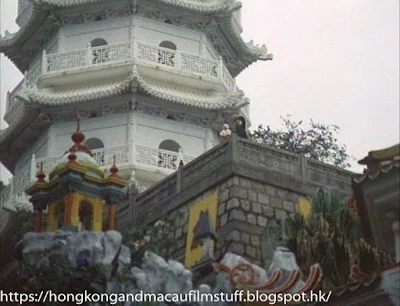


Lots of snaps but all worthy of inclusion I feel simply because this place has gone and won't be back. I think that there should have been efforts to preserve the pagoda as well but it wasn't to be. I will head back there at some point and show you all what's left.
Anyway, another part of the Affair in T'sien Cha sees our intrepid duo here as well wandering around not only the gardens but also the terrace and swimming pool that were adjacent to the mansion.


Lots of snaps but all worthy of inclusion I feel simply because this place has gone and won't be back. I think that there should have been efforts to preserve the pagoda as well but it wasn't to be. I will head back there at some point and show you all what's left.
Sunday, September 1, 2013
I Spy (TV Series) - Robert Culp (1965) - King Yin Lei, Hong Kong
Let's kick off the I Spy posts with the beginning of the episode entitled Affair in T'sien Cha. The location should be very familiar to anyone who has read either of my two HK-based blogs. Yes, it's our trusty Chinese-styled house above Wanchai - 8 years before it became the distant lair of the nefarious Han, and ten years after it was the abode of Clark Gable.


For those familiar with the series itself, you will know that the premise is that Robert Culp plays a tennis player who travels the world participating in competitions and Cosby is his coach - but of course the roles are just a cover for their real work as spies.
What I hadn't realised, and which I have to thank AP for making me aware of is that - as you can see - King Yin Lei used to have a (grass, no less) tennis court right at the front of the property, next to Stubbs Road! I had no idea until AP sent me these caps - anyway, sadly the court was buried under a land slip during a typhoon the following year (1966).


For those familiar with the series itself, you will know that the premise is that Robert Culp plays a tennis player who travels the world participating in competitions and Cosby is his coach - but of course the roles are just a cover for their real work as spies.
What I hadn't realised, and which I have to thank AP for making me aware of is that - as you can see - King Yin Lei used to have a (grass, no less) tennis court right at the front of the property, next to Stubbs Road! I had no idea until AP sent me these caps - anyway, sadly the court was buried under a land slip during a typhoon the following year (1966).
Subscribe to:
Posts (Atom)