The very last scene in the film was shot back up towards Ponte No.17. Essentially the waterfront area that disappeared when the Sofitel Hotel was built at the inner harbour end of Avenida de Almeida Ribeiro. In the top image we can see the police car driving up Rua das Lorchas towards the camera with Ponte No.16 (built in 1948) on the right hand side and on the left of the image is the edge of the Hotel Grande.
The car goes by and immediately turns into a waterfront area that no longer exists and is instead these days occupied by part of the Sofitel development. The grey painted shack on the waterfront should be the no-longer-existing Ponte No.17 (Pontes 17 through 20 have all gone the way of the Dodo due to the hotel development).
Showing posts with label Hotel Grande. Show all posts
Wednesday, June 12, 2019
Wednesday, June 5, 2019
Narazumono - Ken Takakura (1964) - Rua das Lorchas, Macau
Hirogami catches up with Minami along Rua das Lorchas along the inner harbour waterfront. In this scene we get a nice front view of the Grande Hotel Kuok Chai in the background as well as the Ponte No.16 building that can be seen between the signboards on the left hand side and you can see the same building further back in the lower image. It's the one with the small clocktower. Both Ponte No.16 and the Grande Hotel are still around (for the time being at least).
Monday, September 11, 2017
Le Monocle Rit Jaune - Paul Meurisse (1964) - Rua do Doutor Lourenco Pereira Marques, Macau
More Macau and a nice view along Rua do Doutor Lourenco Pereira Marques when it still had open views to the inner harbour. These days the old "pontes" have all been built up or replaced by waterside warehousing. This first shot shows us looking north and in the background can be seen the old Grande Hotel (extreme top left) and just in the back middle of the shot is the old Opium godown which can also be seen in this post I did a while back for Indiana Jones and the Temple of Doom. Both buildings are still around (at least they were the last time I was in Macau).
Sunday, January 17, 2016
Macao - Robert Mitchum (1952) - Rua do Visconde Paco de Arcos, Macau
Having just been talking about the Hotel Grande in the previous post, this view shows the back of the hotel from the vantage point of the inner harbour area.
The hotel is actually the large structure on the right. I've passed this place almost every time I have visited Macau and never realised it had such a varied history. The building looks quite modern, at least compared to the older shop houses that line Avenida de Almeida Ribeiro next to it and was in fact built in 1940, just before the war broke out between Japan and neighbouring China. Macau, being a Portuguese colony remained neutral during the occupation years and as a result saw lots of wealthy refugees from Hong Kong escaping the Japanese oppression.
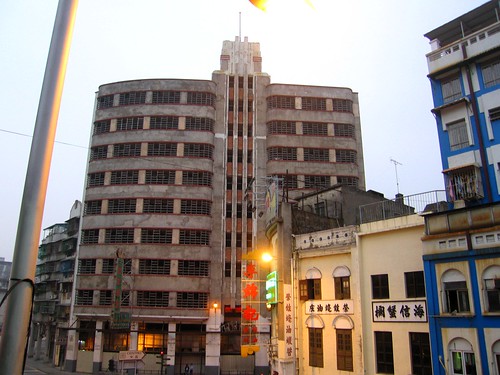
The Grande Hotel (Chinese name Kwok Chai Tsau Dim) was built by the Tai Hing Company - a company owned by the Fu family who controlled the gambling monopoly between 1937 and 1962. Their lasting contribution to Macau, other than this rather elegant (though dilapidated) shell of a building was to introduce baccarat into local casinos. It was supposedly built with Chinese patrons in mind, as opposed to the various other luxury hotels that catered largely for western visitors. On completion it was the tallest structure in Macau, topping out higher than its neighbour Hotel Central (which can be seen in the background in the above screen caps). Incidentally, it was the Fu Family that built and owned the popular Furama Hotel in Hong Kong.
Unfortunately it didn't take long before the place descended into a rather less-than-salubrious destination with all manner of crimes going on including murders, prostitution and drug dealing etc and it eventually closed down in the 1990s and has been sitting there ever since getting more and more decrepit. I think this is a big shame because it is actually a very attractive building. I recently heard some rumours that there was an investor waiting to restore it to its former (pre-vice) glory and I hope it happens because something needs to be done and it would be a shame to just knock it down.
Incidentally, the wooden pier you can see in the foreground is now occupied by the Sofitel development and the tall building on the left is the (also still standing) Hotel East Asia. This isn't the Ponte No.16 because that is a large concrete art deco structure, so this looks more likely to be the next pier up, Ponte 18 (I don't know if there was a #17). I'm hoping someone more familiar with Macau can comment. Anyway, this was the pier where passengers were filmed disembarking from the ferry (I assume it was the Tak Shing that was featured in the movie, but I haven't looked closely enough to confirm yet). The footage was used twice, once on it sown and then a few seconds later as the background for the studio scenes of Mitchum and Russell disembarking.
Sadly, I don't have my own picture of the Hotel Grande but here is one courtesy of meckleychina on FLICKR. He also has a great collection of pictures of Asian art deco if you are interested.
Friday, January 15, 2016
Macao - Robert Mitchum (1952) - Avenida de Almeida Ribeiro, Macau
A brief but almost recognisable glimpse along the far (western) end of Avenida de Almeida Ribeiro aka San Ma Lo. This is one of my favourite roads in Macau because it is largely lined along both sides with columned shop houses, including a couple of interesting pawn shops. Probably the most well-known film featuring this road was Indiana Jones and the Temple of Doom.
Anyway, the view we get in this film is of the end that used to open out onto the inner harbour area with the less-than-salubrious but long closed down (and now derelict) Hotel Grande at the end. Despite the poor film quality, you can still make out some distinguishing features that give away the location including some of the cornice of the near archway and the extra high columns that support the front facade of the Hotel Grande building.
There's an interesting history to the aforementioned hotel, but I'll cover that in the next post where we see a bit more of it. Until then, here is the rough approximation of the modern view courtesy of Streetview. Note that the open end of the road is now blocked by the Sofitel.
Subscribe to:
Posts (Atom)